The juice is finished. The bottle is picked. And then comes the question that stalls more indie fragrance launches than either of those: the box. In a typical r/DIYfragrance thread, a maker with thin 10 ml bottles — 0.6 by 4.8 inches — asks where to find a supplier who can do "nice custom printing" on a box that small. The answers usually split between "Etsy stock boxes" and "good luck under 1,000 units." Both are wrong, and this guide is the answer we give when that question lands in our factory inbox.
Perfume packaging is a special case among gift boxes because it has to do two jobs that pull in opposite directions: immobilize a heavy little glass vessel well enough to survive a courier network, and open like a counter at Selfridges. Get the second without the first and you'll be refunding chipped flacons. Here's how to spec both, with the real numbers — MOQs, unit costs, clearances — that a factory works from.
Scope: This guide covers the primary presentation box — the one the bottle lives in — for glass bottles from 5 ml discovery vials up to 100 ml flacons and multi-bottle coffrets. Outer shipping cartons are a separate topic. All prices are typical 2026 EXW factory-direct ranges; your dieline, finish list and quantity decide the real number, so treat these as planning figures and quote against your actual spec.
What a perfume box has to do (four jobs, in order)
Most packaging regret we see comes from brands optimizing job three and discovering jobs one and two in their first month of shipping. The fix costs nothing at the dieline stage and a reprint after launch, so run the order above.
The four structures that work for fragrance
Shoulder-neck rigid box. The prestige classic: a lid that glides down over an inner "neck," giving that slow, air-cushioned opening you know from niche houses. Because the neck adds a visible reveal line, it reads expensive before the customer sees the bottle. It's our recommendation for single flacons at a $60+ retail price point. See the construction on our shoulder-neck rigid box page.
Lid-and-base two-piece. Simpler than shoulder-neck, still fully rigid, and the workhorse for 30-100 ml single bottles. Add a ribbon pull or wrist ribbon and it doubles as retail gifting. Construction details: lid & base rigid box with ribbon.
Magnetic closure box. The front flap opens like a book — theatrical, flat-laying, and the natural choice for coffrets and gift sets where the customer should see everything at once. Our magnetic rigid boxes start at 100 pieces, which is why they've become the default first custom box for indie brands.
Sliding drawer box. For discovery sets — 5 to 10 small vials in a die-cut tray — a drawer box is thinner, cheaper, and slides through letterboxes, which matters if your discovery set ships untracked mail. The drawer action also survives repeated opening better than any hinge.
A printed folding carton (the thin paperboard box most designer perfumes at Sephora sit in) is the fifth option: lowest unit cost, prints beautifully, but it's a carton, not a rigid box — it needs an insert to protect glass and it won't be kept on a dresser. Fine for wide retail distribution; usually the wrong call for a DTC niche brand whose box is half the product story.
Size around the bottle — a worked example
Factories size perfume boxes from the bottle outward, and you should too. The arithmetic for a typical 50 ml flacon, 42 × 42 × 98 mm with the cap on:
- Cavity: bottle dimension + 2-3 mm total clearance → 44-45 mm square, 100-101 mm tall. Tighter and assembly slows down; looser and the bottle rattles.
- Insert walls: at least 10-12 mm of EVA around the cavity to absorb a corner drop → interior of roughly 66 × 66 × 112 mm.
- Box walls: rigid boxes are built on 2-3 mm greyboard plus wrap → external size lands near 72 × 72 × 120 mm.
Now the Reddit case — thin 10 ml vials of 15 × 122 mm. A six-vial discovery drawer works out to cavities of ~17-18 mm diameter with 8-10 mm webs between them: a tray of roughly 150 × 95 mm holding six vials laid flat, in a drawer box under 35 mm thick. That's a letterbox-friendly set, and at 10 ml sizes the insert — not the box — is most of the engineering. If you'd rather not do this math, send your bottle drawing to a factory; we return a free dieline and 3D mockup in about 48 hours, and our gift box size guide has standard interior dimensions if you want to sanity-check against common sizes.
Inserts: what actually holds the glass
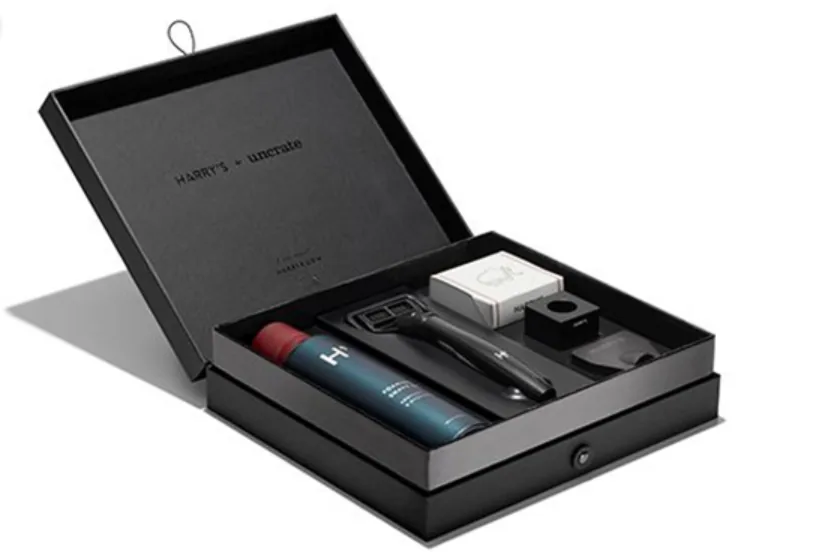
Four insert families matter for fragrance, in rough order of protection:
- Die-cut EVA foam — the protection benchmark for glass. Dense, precise cavities, available plain, flocked, or velvet-wrapped for prestige interiors.
- Velvet or satin-wrapped foam — same mechanics, dressed for the reveal. Standard in the $100+ tier.
- Molded paper pulp — plastic-free and increasingly what EU-focused brands request; fine thermoformed pulp now has a smooth, intentional surface that no longer looks like an egg carton.
- Card platforms — for folding cartons and light vials only; they position, but don't cushion.
Which one is right depends on bottle weight, sustainability positioning and budget — we've written a full comparison in our EVA foam vs molded pulp vs cardboard insert guide, and the materials guide tabulates the options. The short version: under 30 ml almost anything die-cut works; over 50 ml of glass, foam or fine pulp with real wall thickness.
Finishes that read "perfume counter"
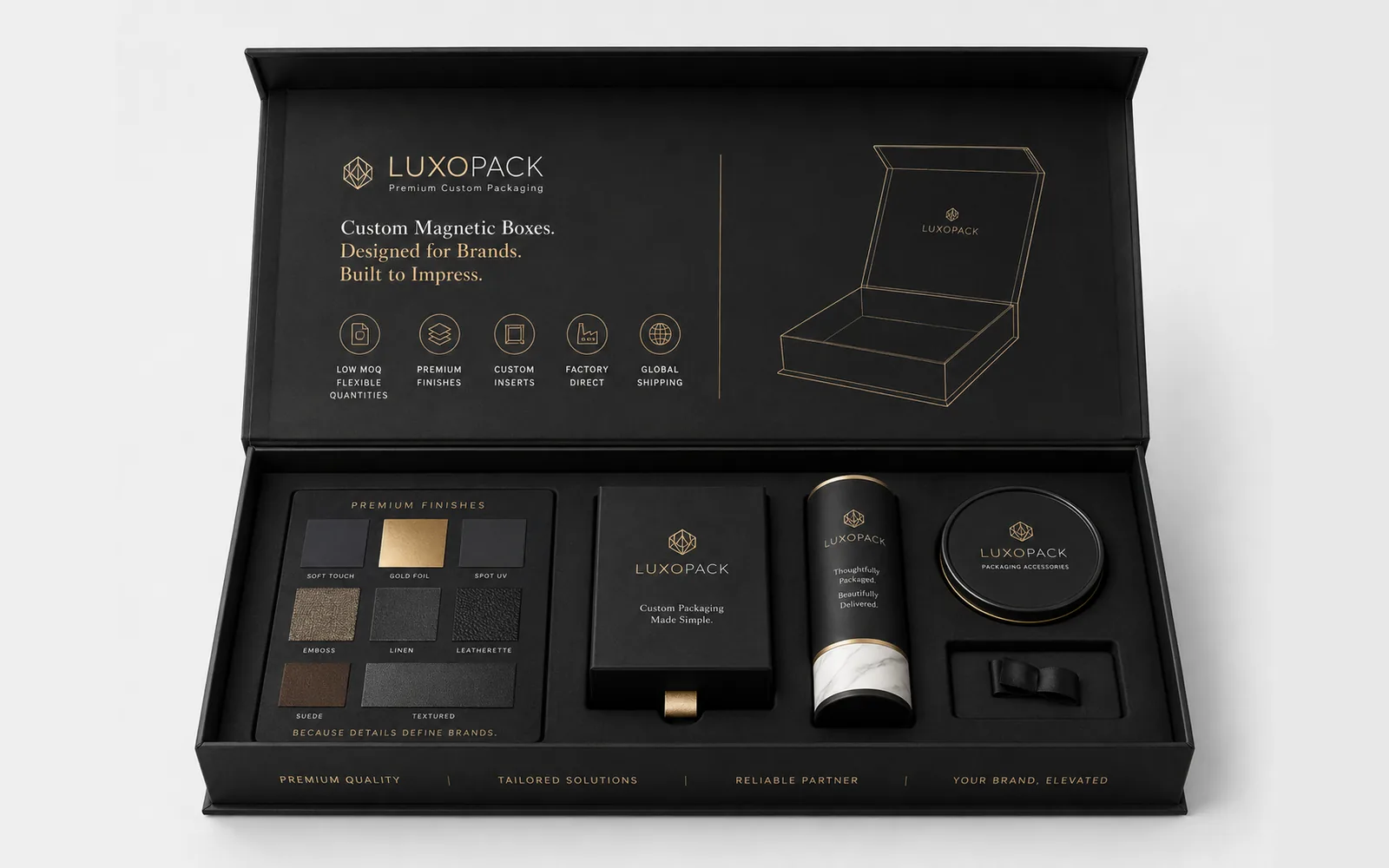
Fragrance buyers touch the box before they smell anything, so finish choices are commercial decisions, not decoration. The combination we cut most for perfume brands: soft-touch (velvet) lamination across the wrap, a hot-foil logo in gold, rose gold or holographic, and a blind emboss pattern or monogram. Soft-touch hides fingerprints — which matters for dark wraps — and foil gives the shelf glint that flat ink can't. Spot UV over a tone-on-tone pattern is the budget path to the same "there's something happening on this box" effect. One warning from production experience: heavy soft-touch plus deep emboss on very dark paper shows scuffs in transit, so ask your factory to sample your exact wrap before committing a full run — sample kits exist for exactly this. Our luxury finishes guide ranks each option by impact per dollar.
Don't forget the interior: a flood-printed inner wrap or a foil moment inside the lid costs little at print time and is what unboxing videos actually show.
What custom perfume boxes cost in 2026
| Construction | Typical 2026 EXW range | Typical MOQ | Best for |
|---|---|---|---|
| Printed folding carton + card insert | $0.55 – $1.20 | 200–300 pcs | Retail distribution, lighter vials |
| Folding carton + die-cut EVA | $0.90 – $1.80 | 200–300 pcs | Mid-tier DTC, 30–50 ml |
| Rigid lid-and-base / shoulder-neck + foam | $1.80 – $3.60 | 100 pcs | Prestige single flacon |
| Magnetic coffret, multi-cavity insert | $3.00 – $6.00 | 100 pcs | Gift sets, holiday coffrets |
Two anchors to calibrate against. First, a live factory reference: our magnetic rigid box on a 200 × 200 × 80 mm basis runs $3.50/unit at 100 pieces and $1.75 at 10,000, with the volume curve stepping roughly −15% at 500, −25% at 1,000, −40% at 5,000 and −50% at 10,000. Second, remember these are EXW numbers — ex-works, at the factory door. Freight, import duty and last-mile handling sit on top; our import duties and tariffs guide walks through the landed-cost math for US buyers, and the price guide lists finish surcharges line by line.
MOQ reality for small fragrance brands
The "1,000 minimum" number that scares indie perfumers off custom packaging is a reseller convention, not a manufacturing constraint. Factory-direct, fully custom rigid boxes are economic from 100 pieces — that's our standing MOQ — and printed folding cartons from 200–300. Below 100 units, honest advice: custom tooling stops making sense; buy a well-made stock box and spend on a foil-stamped logo and printed tissue instead, then graduate to custom at your first 100-unit reorder. Because dielines, 3D mockups and stored tooling are free at most factory-direct makers (they are at ours), the second order costs less friction than the first — see the MOQ guide and low-MOQ program for how the tiers break.
Artwork and compliance: leave room for the boring panel
Before artwork goes to print, reserve one face — usually the base or back — for the text that regulators and retailers expect: net contents in both notations ("50 mL ℮ 1.7 FL.OZ."), batch/lot code position, EAN/UPC barcode with quiet zone, country of origin, and for EU sales the responsible-person name and address line. None of it is difficult; all of it is miserable to retrofit after a 5,000-unit print run. If your perfume is alcohol-based, note that dangerous-goods rules apply to the shipment (UN 1266, limited-quantity provisions), which shapes the master carton and carrier paperwork rather than the gift box itself — but your freight quotes will reference it, so it belongs in the same planning conversation. Our print-ready artwork guide covers bleed, Pantone vs CMYK and the pre-flight checks that prevent the classic reprint disasters.
Have bottle dimensions? That's all we need to start.
Send your bottle size (or a photo with a ruler) and we'll return a free dieline and 3D mockup in about 48 hours, with EXW pricing at 100 / 500 / 1,000 pieces. Pre-production samples in 3-5 days.
Get my perfume box quoteFrom bottle spec to purchase order: the 7-step path
- Measure the bottle with the cap on — width, depth, height, and weight filled. Note the sprayer type; some over-caps need headroom.
- Pick the structure by channel: shoulder-neck or lid-and-base for single prestige flacons, magnetic for sets, drawer for discovery kits, folding carton for wide retail.
- Choose the insert by glass weight and brand positioning — foam for protection benchmark, fine molded pulp for plastic-free positioning.
- Set your quantity tier against a unit-cost target using the table above; ask for pricing at three quantities so you can see your own curve.
- Request the free dieline and 3D mockup and place your legal text panel now, not after design sign-off.
- Order a pre-production sample (3-5 days) and run the shake test: if you can hear the bottle, tighten the cavity 1 mm and re-cut.
- Approve artwork, confirm the production window — 12-18 days bulk after approval — and book freight with your launch date, not your invoice date, as the anchor.
Perfume is the category where packaging most directly is the product experience — the box outlives the last spray on most dressers. Spec it like an engineer, dress it like a creative director, and it will pay for itself in unboxing posts alone.
Frequently Asked Questions
LuxoPack is an FSC-certified rigid box factory in Shenzhen (est. 2010) building perfume and cosmetic packaging factory-direct, MOQ 100. Related reading: Perfume Packaging Solutions, EVA Foam vs Molded Pulp vs Cardboard Inserts, Luxury Packaging Finishes Guide, Gift Box Size Guide, MOQ Guide.