Chinese New Year 2027 falls on Saturday, February 6 — the Year of the Goat — with the official holiday expected to run roughly February 4-12. If that's all you knew, you'd plan for a nine-day pause. That's the mistake this article exists to prevent: for manufacturing buyers, the practical disruption spans six to eight weeks, from the mid-January wind-down to the early-March return to full output. Importer and QC guides are unanimous on the planning consequence — final production orders for anything you need in early Q1 belong in September or October.
You're reading this in summer 2026, which means you're exactly on time. Here is the reverse calendar we work from on our own production floor, written for packaging buyers — and worth bookmarking, because every deadline in it arrives faster than it looks.
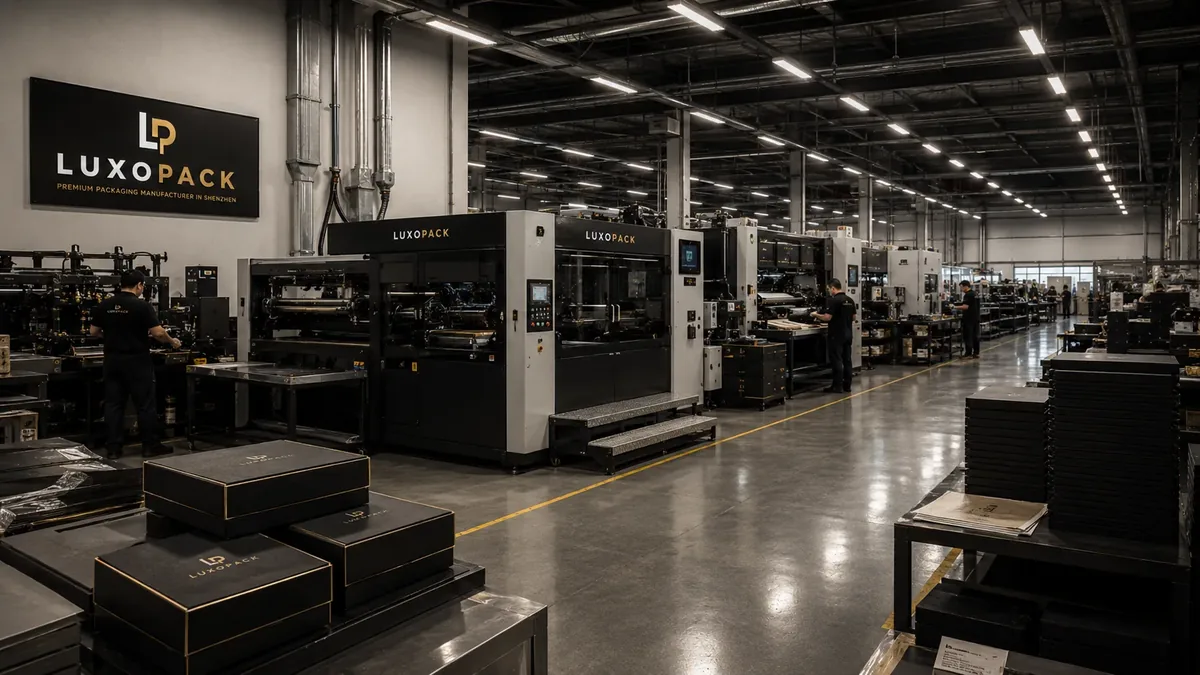
Date disclaimer: February 6, 2027 is fixed by the lunar calendar, but each factory's last-production day, last-shipment day and return date are set by its own order book and region. Treat the calendar below as the planning skeleton, and get your specific suppliers' cut-off dates in writing — ask "what is your last production date and last shipping date before CNY 2027, and when do you return to full capacity?" and hold them to the answer.
What actually happens inside a factory around CNY
Chinese New Year is the largest annual human migration on earth — hundreds of millions of workers travel home, many across the country. A packaging factory doesn't flip a switch on February 4; it powers down in stages, and it's the stages that eat your schedule:
- Upstream closes first. Board mills, paper merchants and ink suppliers stop shipping before converters stop producing. A factory can be "open" in late January and still unable to start your job because greyboard deliveries already ended.
- Workers leave early. Long-distance staff begin traveling one to two weeks before the holiday. Lines run shorter-handed each day of late January.
- Logistics thins out. Trucking capacity to the ports drops as drivers head home — goods that are finished but not collected can strand at the factory over the break.
- The restart is staggered. After the official break, staff return in waves over one to three weeks. Industry guides consistently note that some share of workers don't return at all each year, which means rehiring and retraining while the backlog clears.
Add the front and back ends together and you get the six-to-eight-week disruption window the freight and QC industry describes — roughly mid-January to early-or-mid March 2027.
The reverse calendar: August 2026 → March 2027
| When | What must happen | Risk if missed |
|---|---|---|
| Aug – early Sep 2026 | Finalize dielines and artwork for Q1 2027 packaging; order pre-production samples (3-5 days at LuxoPack) | Sampling iterations push your PO into the crowded window |
| Mid-Sep – Oct 2026 | Place bulk POs for anything needed February–April 2027 | Pre-CNY capacity sells out; late POs queue behind everyone else's |
| Nov 2026 | Production runs; book ocean freight 3-4 weeks ahead of target sailing | Freight rates begin their pre-CNY climb |
| Early Dec 2026 | Last comfortable PO date for standard runs (12-18 day production) shipping pre-CNY; pre-shipment QC on finished goods | No slack left for a re-run if QC finds a problem |
| Late Dec – first week of Jan 2027 | Containers depart — forwarders' recommended final window while trucking holds | Mid-January sailings face rollovers and peak rates |
| Mid – late Jan 2027 | Last-resort shipments only; expect premiums and congestion | Goods finished but not trucked can strand for 3+ weeks |
| Feb 4 – 12, 2027 | Official holiday — factories dark, ports on skeleton staff | — |
| Mid-Feb – early Mar 2027 | Staggered restart; backlog clears oldest-first; blank sailings reduce vessel space | New orders placed now join the back of the queue |
The row that surprises people is the second one. September feels absurdly early when the holiday is in February — but walk it backwards: goods on the water by early January means production finished by late December, means artwork locked and PO placed by late November if nothing goes wrong. The September-October convention that importer guides teach exists to buy you the slack for the things that do go wrong: a sample revision, a materials delay, a full QC re-run. Our lead-time guide breaks down where each of those days lives.
Why Q4 makes it worse: the double squeeze
Packaging buyers get squeezed twice in the same quarter. Your own Q4 is peak season — holiday gift boxes, advent calendars, New Year corporate gifting — and it shares the exact same print lines, die-cutters and hand-assembly benches as everyone else's pre-CNY stockpiling. Factory capacity in November and December is effectively an auction where the early POs already took the slots. This is why the brands that sail through January are the ones whose holiday packaging POs landed in summer: their Q4 production was locked before the squeeze, and their Q1 orders joined the queue in September instead of competing in it in December.
Freight around CNY: the spike, the window, the silence
Ocean freight has its own CNY curve. In the two to four weeks before the holiday, rates climb and space tightens as every exporter in China races the same deadline; forwarder guidance is to target departures in the last week of December or first week of January, while truckers are still working and port rollovers are less frequent. Then comes the part first-time importers don't expect: after the holiday, carriers cancel sailings ("blank sailings") for several weeks because there's little cargo to carry — so even once your factory is back, vessel space is thinner than normal. Practical rules: book space three to four weeks ahead on either side of the holiday, don't schedule anything that matters for the mid-January scramble, and if goods will finish late January, decide in advance whether they wait at the factory (safe, but adds weeks) or race the last truck (fine until it isn't).
QC before the rush — January is when defects escape
The weeks before CNY are the highest-risk QC window of the year: lines run overtime, temporary workers fill gaps left by early departures, and everyone — factory and buyer alike — feels the pressure to ship at all costs. The discipline that protects you is simple and non-negotiable: pre-shipment inspection on every pre-CNY order, booked when you place the PO rather than requested at the end when inspectors' calendars are full. If inspection fails in early December, there's time for a re-run; if it fails on January 20th, your real choice is between shipping defects and waiting until March. Never let the calendar talk you into skipping the check — a container of flawed boxes that arrives in February isn't faster than a good one in March, it's just more expensive. Our guide to verifying a China packaging factory covers what a proper inspection looks at.
If you miss the window: the three honest fallbacks
- Split the order. Produce whatever fits before the cut-off — even 30% of the run — to cover February and March, and schedule the balance as the factory's first post-CNY job. Splitting costs a second freight booking; it's almost always cheaper than running out.
- Simplify for speed. Stock board grades, one fewer finish process, digital print instead of plates: each shaves days, and together they can pull a January order inside the last window. Ask the factory "what would you remove from this spec to ship it before CNY?" — it's a question they answer honestly, because they'd rather ship simplified than not at all.
- Bridge locally. A domestic converter can cover four to six weeks at a higher unit cost while your main run waits. Expensive per box, cheap per crisis. What rarely works: air-freighting packaging. Boxes are volume, not value — air rates are billed on exactly the dimensional space empty boxes are made of. Reserve air for small emergency quantities and accept the math will hurt.
How we run CNY 2027 at LuxoPack
For calibration, our own numbers: standard production is 12-18 days after artwork approval, samples 3-5 days year-round outside the break, and tooling is stored free — so post-CNY reorders restart without re-setup. Practically, that makes early December 2026 our last comfortable PO date for standard runs shipping before the holiday, earlier for high volumes or heavy hand-assembly work, and we confirm exact cut-offs on every purchase order placed from September onward. Q1 2027 production slots are scheduled in the order POs land — which is the polite way of saying what every factory means in the autumn: the calendar is first-come, first-served.
Lock a Q1 2027 production slot before the queue forms
Tell us what you'll need between January and April 2027 — even approximate quantities — and we'll hold a production window, confirm your exact pre-CNY cut-off dates in writing, and schedule sampling now while there's slack to iterate. MOQ 100 pcs.
Reserve my production windowThe 8-point CNY 2027 readiness checklist
- Map your Q1-Q2 2027 packaging needs now — anything you'll ship to customers between February and April needs boxes ordered in autumn 2026.
- Get every supplier's cut-off dates in writing: last PO date, last production date, last shipping date, return-to-capacity date.
- Finalize artwork by early September and run pre-production samples while iteration is still cheap.
- Place bulk POs mid-September to October for pre-CNY delivery; treat November POs as already-late.
- Book ocean freight 3-4 weeks ahead, targeting departures by the first week of January 2027.
- Book pre-shipment QC with the PO, not after production — December inspection slots fill up too.
- Decide your miss-the-window fallback in advance (split, simplify, or bridge) so a January delay triggers a plan, not a panic.
- Diarize the restart: assume full capacity returns early-to-mid March 2027, and queue your post-CNY orders in January so they're first in line.
None of this is complicated — it's just early. The buyers who have a calm February are indistinguishable from everyone else except for one thing: their calendars started in September.
Frequently Asked Questions
LuxoPack is a Shenzhen rigid box factory (est. 2010) — we publish our CNY cut-offs on every autumn PO and hold Q1 slots in booking order. Related reading: Custom Packaging Lead Times Explained, Holiday Gift Box Packaging Wholesale, How to Verify a China Packaging Factory, Import Duties & Tariffs Guide, Subscription Box Packaging Costs.